
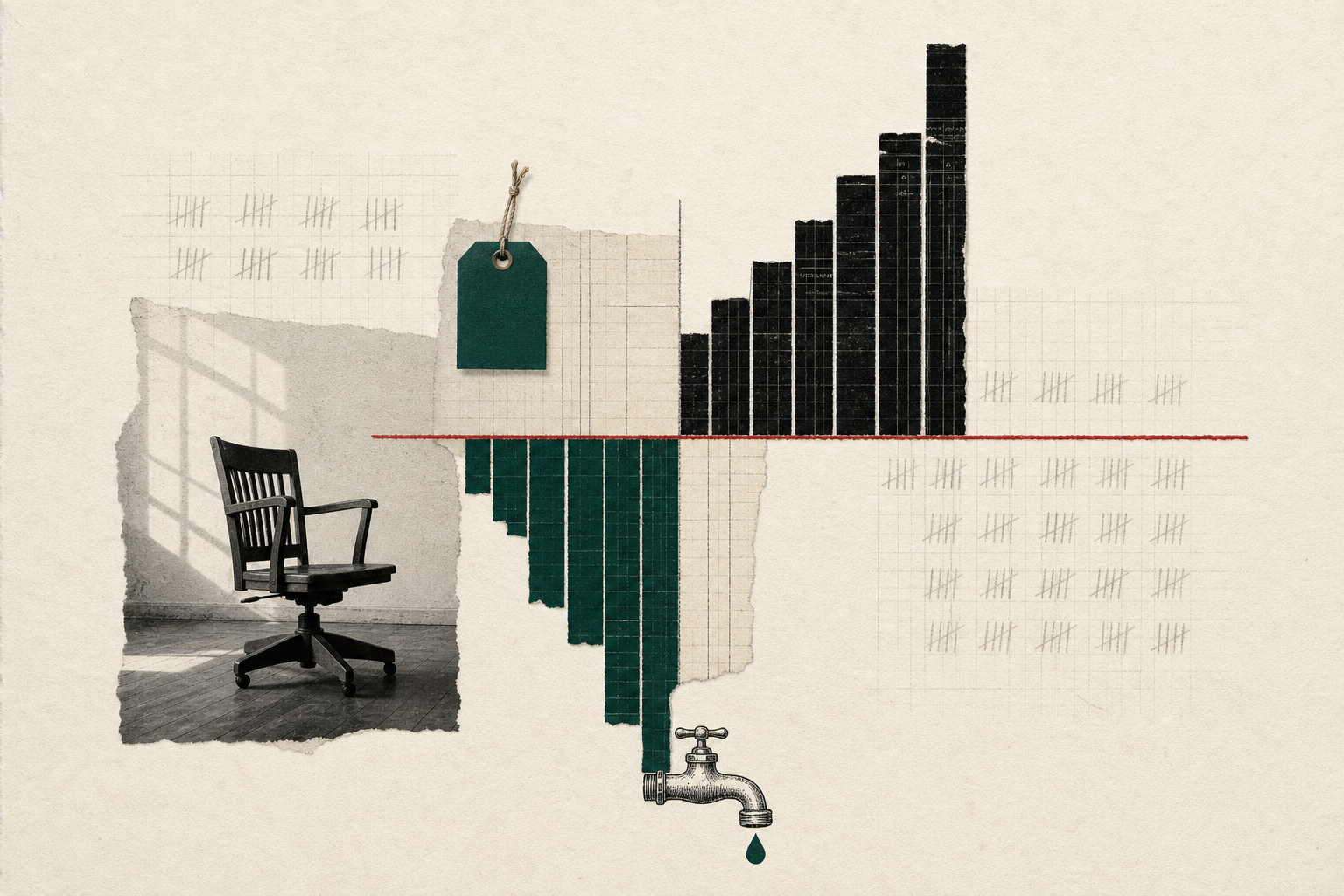
A growing body of administrative-data research suggests that if AI is reshaping employment, the most visible early effect may not be mass layoffs — it may be a quiet contraction in the first jobs that young workers depend on to begin a career.
What the Stanford study measured
The core findings come from a paper by Stanford economists Erik Brynjolfsson, Bharat Chandar and Ruyu Chen, titled Canaries in the Coal Mine? Six Facts about the Recent Employment Effects of Artificial Intelligence. The August 2026 paper — an update to an earlier 2025 analysis — draws on a high-frequency administrative payroll sample from ADP, covering millions of U.S. workers, with data running through June 2026.
The researchers tracked employment by age group and by occupational exposure to AI, then compared how different groups fared over time. Their principal finding concerns workers aged 22–25 in occupations classified as highly exposed to AI.
“Employment of young workers (ages 22–25) in AI-exposed occupations now stands 19% below where it would be had it kept pace with that of their less-exposed peers.” — Brynjolfsson, Chandar and Chen, August 2026
That 19% figure demands careful reading. It is a relative shortfall against a constructed benchmark — not a 19-percentage-point rise in unemployment, not a count of jobs eliminated, and not a claim about all young workers. The comparison asks: if employment among the more-exposed group had grown at the same rate as employment among less-exposed young workers since late 2022, where would it be? The answer is about 19% higher than where it actually landed.
The underlying level comparison adds texture. Between November 2022 — roughly when ChatGPT launched — and June 2026, employment among 22–25-year-olds in the two most AI-exposed quintiles of occupations fell roughly 11%, while employment for the same age group in the three least-exposed quintiles grew roughly 10%. That divergence, not the absolute level, is what the 19% captures.
The same “kept pace” shortfall was 15% at the July 2025 data vintage — meaning the gap has widened over the past year. The researchers also reported earlier regression-adjusted estimates (13% in July 2025, 16% in September 2025), but the August 2026 paper explicitly moves away from those in favour of the simpler descriptive comparison. These are different measures, not a single figure that has ticked steadily upward.
Why “fewer hires” is the central mechanism
The paper’s most consequential structural finding is how the gap forms. The divergence appears primarily through reduced hiring, not through a comparable rise in separations among workers already employed.
Think of a company’s workforce as a bathtub. Pulling the drain plug empties it through layoffs and attrition. But you can lower the water level more quietly, simply by reducing the flow in — by hiring fewer people in the first place. Layoff statistics watch the drain; they can look perfectly normal while the faucet is being turned down.
If that is what is happening, traditional labor-market warnings — separation rates, unemployment filings, mass-layoff announcements — would not catch it early. The Stanford analysis makes hiring flows the relevant variable to watch alongside separations.
The researchers also find no comparable employment divergence for experienced workers. Older workers in AI-exposed occupations do not show the same relative gap against their less-exposed peers. And the declines are concentrated in occupations where AI usage is classified as primarily substituting for human task performance, rather than those where it primarily complements workers — where employment is flat or rising, particularly for experienced staff.
The authors are explicit about what they have and have not established:
“We interpret these facts as early, descriptive indicators — canaries in the coal mine — rather than causal estimates.” — Brynjolfsson, Chandar and Chen, August 2026
The paper cannot determine how much of the observed trend was caused by generative AI rather than correlated with it. Workers are not randomly assigned to AI-exposed occupations. The ADP records do not establish that AI adoption prompted any particular hiring decision.
Two independent studies point the same direction
The Stanford/ADP findings do not stand alone. Two separate Census Bureau working papers, using different datasets and methodologies, reach broadly consistent conclusions about early-career workers.
Lee C. Tucker’s April 2026 paper, You’re (not) hired: Artificial intelligence and early career hiring in the Quarterly Workforce Indicators, uses Quarterly Workforce Indicators (QWI) — a distinct employer–employee administrative dataset — and focuses on workers aged 22–24. Tucker links occupational AI-exposure scores to industry–state cells rather than using the ADP analysis. The paper reports that hires of early-career workers in the most AI-exposed cells fell immediately by 9% relative to less-exposed cells after ChatGPT’s release. Regression-adjusted employment in the most exposed quintile fell 12% over the following ten quarters. Tucker estimates the overall reduction in hires explains a 15% decline in employment in the most exposed industries, which he describes as more than 150,000 early-career jobs — though that is a study estimate, not a verified count of identified workers.
Tucker also identifies important qualifications: some relative trends begin around the onset of the COVID-19 pandemic; remote work and educational attainment may play a role; and a monetary-policy analysis suggests interest-rate shocks could explain up to one-quarter of the adjusted employment gap through the second quarter of 2025. Tucker concludes that interest rates do not explain the rapid reduction in hires at the most-exposed firms, but the paper’s cover notes its conclusions are the author’s own and do not represent a Census Bureau position.
A second Census working paper, Graduating into Disruption: Labor Market Outcomes for AI-Exposed College Majors by Cody Orr, Lee Tucker and Lawrence Warren (September 2026), narrows the lens to graduates specifically. The study covers roughly 29% of U.S. bachelor’s degrees conferred from 2016 to 2024. It reports that graduates from the most AI-exposed decile of majors faced a five-percentage-point decline in the likelihood of employment in the quarter after graduation, and roughly 13% lower initial full-quarter earnings compared with graduates from less-exposed fields. The earnings gap attenuated to about 5% after two years, accompanied by a reported shift away from higher-paying sectors such as information and professional services toward lower-paying sectors including retail, accommodation and food services. The paper says it cannot yet determine whether or when affected graduates will catch up.
These three analyses use different populations, different data sources and different exposure classifications. They are not independent replications of a single experiment — their designs and measures differ — but their convergence on reduced early-career hiring as a primary channel is consistent.
What “AI-exposed” does and does not mean
None of these studies directly observe an employer deciding to use AI instead of hiring a person. “AI exposure” is a classification of occupational tasks — an estimate of how susceptible those tasks may be to AI effects — not a confirmed record of automation.
The Stanford paper distinguishes between occupations where AI use is classified as more substitutive (AI performs tasks in place of workers) and those where it is more complementary (AI assists workers who retain the task). Tucker’s separate measure, described in his paper, takes task-level exposure scores derived from O*NET occupational data and GPT-4 assessments of whether a large language model could reduce task completion time by at least 50%, then weights those into industry–state employment cells. That methodology applies to Tucker’s paper; it should not be assumed to describe the Stanford/ADP exposure classification in detail.
The important point is that exposure of some tasks does not mean an entire occupation is automated, that a given employer has adopted AI, or that every worker in a classified occupation is affected. The 19% shortfall applies to a defined age group within classified occupations in the ADP sample; it is not a claim about all young people or all workers in fields touched by AI.
What the evidence does not support
The Stanford authors are careful about the limits of their work, and so are the Census researchers. Several claims that might flow naturally from these headlines are not established by the underlying studies:
- AI caused the employment gap. The researchers explicitly describe their findings as descriptive, not causal. Some occupational divergence predates ChatGPT. Education levels correlate with occupational exposure and may partly explain the patterns — though the authors note this could also be a channel through which AI affects work, rather than a pure confound.
- This represents economy-wide job displacement. The Stanford paper’s first principal finding is that it finds no evidence of widespread, economy-wide displacement in its data. The gap is concentrated in a defined age group and exposure category.
- The 19% is 19% of young workers out of work. It is a relative shortfall against a benchmark, as described above.
- The trend will continue. The data run through June 2026. The authors explicitly state they make no predictions about future impacts and do not claim the trends will continue indefinitely.
- The ADP sample is nationally representative. The authors note that the divergence is more pronounced in the ADP sample than in national survey benchmarks, and that firms using ADP may not fully represent all U.S. employers.
“The data we present provide a snapshot of the labor market in the present. We do not make predictions about future impacts or claim that the trends we document will continue indefinitely.” — Brynjolfsson, Chandar and Chen, August 2026
Why this matters for how labor markets are monitored
The combined evidence raises a monitoring question that extends beyond any single study. If a primary mechanism by which AI affects employment is reduced entry-level hiring rather than incumbent layoffs, then watching separation rates and mass-layoff announcements will not provide early warning.
The implications are distributional as well as aggregate. Experienced workers in exposed occupations show no comparable gap in the Stanford data. College graduates in exposed majors show some attenuation of earnings penalties after two years, but the Orr–Tucker–Warren paper cannot yet say whether they ultimately catch up. The concern is not that AI is making all workers unemployable — these studies do not support that — but that costs may fall unevenly on people trying to enter the workforce, while conventional indicators remain quiet.
What these studies do call for, in the authors’ own framing, is better measurement. Tracking hiring flows by age and exposure alongside separation rates, and building richer data on whether early-career employment patterns in this period translate into lasting disadvantage or temporary adjustment, would let researchers and policymakers assess a risk the current evidence identifies but cannot yet fully characterize.
Sources and method
Primary sources checked:
- Brynjolfsson, Chandar and Chen, Canaries in the Coal Mine? Six Facts about the Recent Employment Effects of Artificial Intelligence, Stanford Digital Economy Lab, August 2026 — principal study; abstract and opening pages (pp. 1–5 of 140) reviewed via an accessible copy. Full appendices not inspected; robustness-check magnitudes (e.g., education-control attenuation) are therefore described qualitatively rather than quantitatively.
- Lee C. Tucker, You’re (not) hired: Artificial intelligence and early career hiring in the Quarterly Workforce Indicators, Census Bureau CES Working Paper 26-27, April 2026 — independent Census working paper; abstract and opening pages reviewed.
- Cody Orr, Lee Tucker and Lawrence Warren, Graduating into Disruption: Labor Market Outcomes for AI-Exposed College Majors, Census Bureau CES Working Paper 26-56, September 2026 — independent Census working paper on graduate outcomes; opening pages reviewed.
- Eloundou et al., GPTs are GPTs: An Early Look at the Labor Market Impact Potential of Large Language Models — original task-exposure methodology cited by Tucker; referenced to explain what “exposure” can mean, not as a direct source for employment estimates.
- SSRC Just Tech summary of the Stanford paper — used as corroborating reference; findings attributed to primary paper.
- CoreMemo reporting on the study — used as corroborating reference; findings attributed to primary paper.
Method note: All numerical claims and direct quotations are drawn from the primary research papers listed above, not from secondary reporting or the provided script. The November 3 date supplied in additional source notes could not be verified as a new primary research release; the verifiable Stanford paper is dated August 2026. That date is used throughout. No links, quotes or measurements were invented; where the accessible text did not contain a figure, the claim is described qualitatively or omitted.